
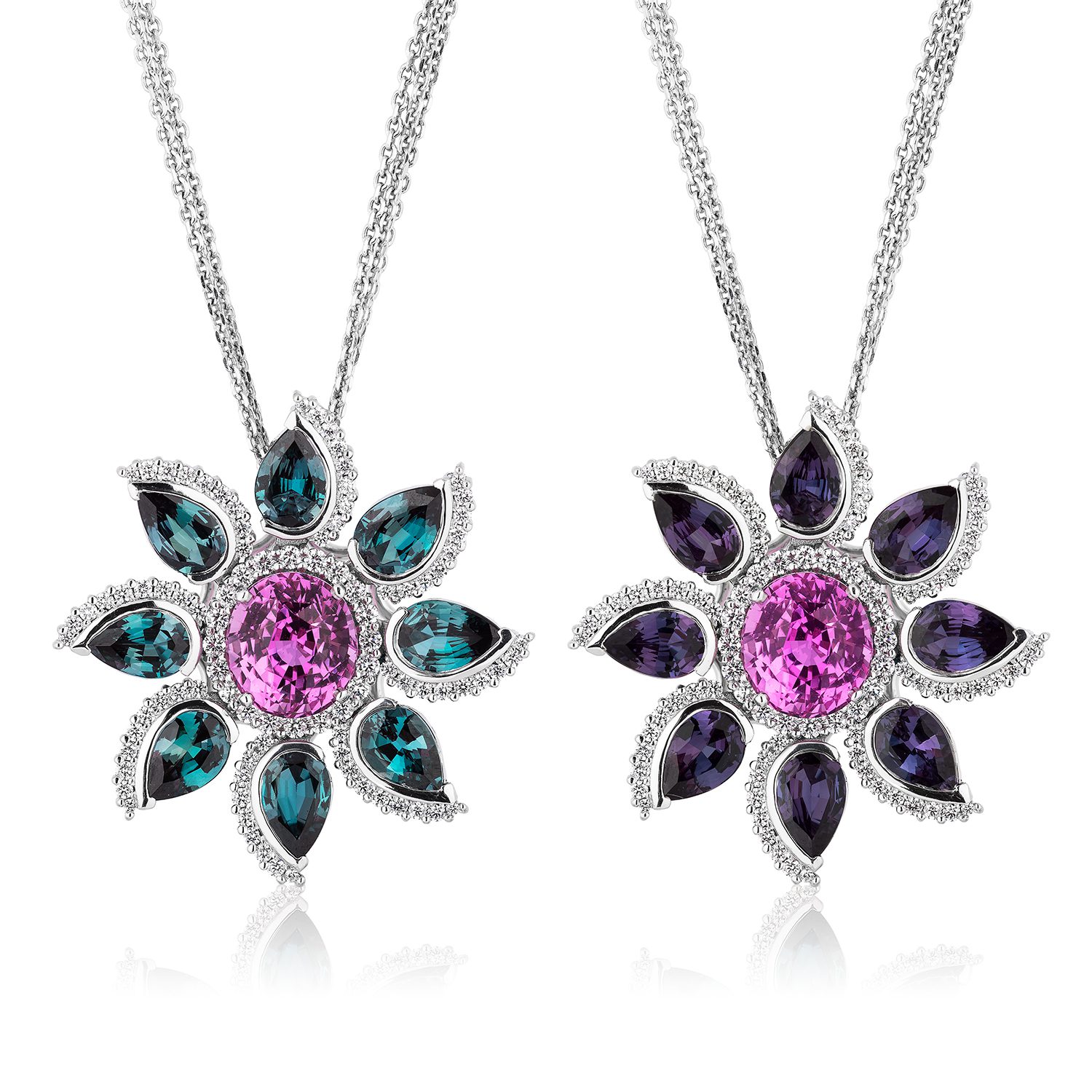
Imagine you are attending a garden party in the late afternoon. As you reach for a glass of lemonade, the ring on your finger sparkles with a lush, verdant green, mirroring the leaves around you. Later that evening, under the warm glow of candlelight at dinner, you glance down at the same ring. To your delight, the stone has transformed into a rich, velvety red.
You haven’t changed your jewelry. You are witnessing one of nature’s most captivating magic tricks.
While most of us know gemstones by a single, static hue—the deep blue of a sapphire or the fire-engine red of a ruby—there exists a rare, enchanting category of minerals known as “phenomenal gemstones.” These treasures possess the remarkable ability to shift colors based on the light source.
In this guide, we will explore the science behind this optical wizardry, dive into the lore of legendary stones like Alexandrite, and share how you can bring this magic into your own jewelry collection.
The Science Behind the Magic: How It Works
How can a solid stone change its appearance so drastically? It isn’t magic, though it certainly feels like it. It is a fascinating interplay of physics and chemistry.
The phenomenon is technically known as the “Alexandrite Effect.” It occurs because of the way specific trace elements within the crystal lattice interact with light. Most color-changing gems contain elements like chromium, vanadium, or iron. These elements are uniquely tuned to absorb specific wavelengths of light while reflecting others.
Here is the simple breakdown:
- Daylight is rich in blue and green wavelengths.
- Incandescent light (like candlelight or tungsten bulbs) is richer in red and orange wavelengths.
A standard emerald looks green because it reflects green light. However, a color-changing gem is balanced on a “tipping point.” It absorbs yellow but transmits both green and red. When the light source is rich in blue/green (sunlight), the gem reflects green. When the light source is rich in red (indoor light), the gem reflects red. This selective absorption creates a stunning, dual-personality gemstone.
Notable Color-Changing Gems: Rare and Remarkable
While several minerals can exhibit color change, two stand out for their dramatic shifts and historical significance.
Alexandrite: The Tsar’s Stone
Alexandrite is the undisputed king of color-changing gems. Its discovery is the stuff of legend. Miners found the stone in the Ural Mountains of Russia in the 1830s. As the story goes, the gem was discovered on the birthday of the future Tsar Alexander II, lending the stone its name.
Because the stone displayed the national military colors of Imperial Russia—green and red—it instantly became a symbol of status and patriotism.
Gemologists often describe fine Alexandrite as “Emerald by day, Ruby by night.” High-quality specimens show a vivid, grassy green in daylight and switch to a raspberry red under incandescent light. It is one of the rarest gemstones on Earth, often commanding prices higher than diamonds.
The Elusive Blue Garnet
For decades, gemology textbooks stated that garnets came in every color of the rainbow—except blue. That changed in the 1990s when miners in Bekily, Madagascar, unearthed a garnet that defied the rules.
These rare Blue Garnets contain high amounts of vanadium. In daylight, they appear blue-green or teal. Under artificial light, they shift to a deep purple or intense pink. Because of their extreme rarity and the fact that “blue” was the final frontier for the garnet family, these stones are highly prized by collectors who want something truly unique.
Symbolism and Folklore: More Than Just a Pretty Stone
Beyond their scientific marvel, color-changing gemstones carry deep spiritual weight. Because they do not adhere to a single state, they are powerful symbols of adaptability and transformation.
Embracing Change
In many cultures, these stones are talismans for navigating difficult transitions. Just as the stone adapts to the light it is given, the wearer is reminded to be flexible and resilient in the face of changing life circumstances.
Balance and Harmony
The duality of the colors represents balance. In Alexandrite, the green represents growth, nature, and peace, while the red represents passion, energy, and power. Wearing a color-changing stone is thought to harmonize these opposing forces within the spirit, promoting emotional equilibrium.
A Flash of Luck
Folklore often associates these shifting stones with good fortune. It is said that the changing color can warn the wearer of impending danger or signal a shift in luck. While we cannot promise your ring will predict the future, it certainly serves as a beautiful reminder that life is never static.
Choosing Your Phenomenal Gemstone
Selecting a color-changing gem requires a slightly different approach than buying a standard diamond or sapphire. The value relies heavily on the quality of the “change.”
Here are the key factors to consider:
- Strength of Change: This is the most critical factor. You want a stone that shifts dramatically. If you have to squint to see the difference between the outdoor and indoor color, the value decreases significantly. Aim for a 100% color shift if your budget allows.
- Distinct Colors: Look for pleasant, saturated colors in both lighting conditions. A stone that looks muddy brown in one light and grey in another is less desirable, even if it technically changes color.
- Clarity: Like all gems, clarity matters. However, because these stones are so rare, collectors often tolerate minor inclusions if the color change is spectacular.
- Certification: Always insist on a report from a reputable gemological laboratory. Because synthetic color-changing stones exist (and are quite common in vintage jewelry), you need expert verification that your stone is natural.
The Magic of Design: Jewelry That Evolves
Designers love color-changing gems because they add an element of surprise to jewelry. A necklace might look cool and professional against a business suit during a lunch meeting, yet turn warm and romantic against a cocktail dress at dinner.
These gems work exceptionally well in:
- Statement Rings: Where the stone is constantly moving through different lighting conditions.
- Pendants: Sitting close to the heart, symbolizing personal transformation.
- Custom Pieces: Mixing color-changing gems with white diamonds creates a stunning contrast that highlights the shifting hues.
Caring for Your Treasure
Owning a piece of nature’s magic comes with responsibility. To keep your color-changing gemstone brilliant for generations, follow these care tips:
- Avoid Thermal Shock: While stones like Alexandrite are hard (8.5 on the Mohs scale), extreme temperature changes can sometimes cause fractures.
- Chemical Safety: Keep your gems away from harsh household chemicals, chlorine, and bleach. These can damage the surface or the setting.
- Storage: Store your color-changing jewelry separately from other pieces. Harder stones (like diamonds) can scratch them, and they can scratch softer stones (like pearls). A soft pouch or a lined jewelry box is ideal.
- Cleaning: Warm, soapy water and a soft brush are usually the best way to clean these stones. Ultrasonic cleaners are generally safe for Alexandrite, but consult with a jeweler before using them on other color-changing varieties.
Experience the Wonder at Olufson Designs
Reading about these stones is fascinating, but seeing them in person is an entirely different experience. The shift from green to red, or blue to purple, is a moment of pure delight that never gets old.
Whether you are looking for a symbol of a major life change, a unique engagement ring, or simply a conversation starter that outshines the rest, a color-changing gemstone is the perfect choice.
Ready to find your own piece of magic?
At Olufson Designs, we specialize in rare and phenomenal gemstones. We invite you to visit our showroom to witness these masterpieces firsthand. Let us help you design a piece of jewelry that doesn’t just sparkle—it transforms.